
Site and content copyright © 2017 by Stylus Productions. All rights reserved.
THE STORY OF THE CHRISTIANS
Volume XIV: On the Eve of the Crusades
Alliances were fleeting and internecine warfare raged, leaving the Magyars, Northmen, and Saracens free to raid, loot, and pillage across the entire continent. Christian Europe seemed to be dissolving in brutal disorder and the Papacy was sinking into moral irrelevance.
Then in the 10th century two men appeared on the scene whose actions eventually turned the tide of turmoil. In 910 Duke William I of Aquitaine founded a monastery on his hunting grounds at Cluny, launching a reform that transformed the Papacy and Christianity itself. And in 955 Otto of Saxony decisively defeated the Magyars. In 962 Pope John XII crowned Otto Imperator Augustus of an empire that would in the 13th century come to be called “The Holy Roman Empire.”
The 10th and 11th centuries would see the Normans take over southern Italy and Sicily. Moslem rule in al-Andalus, especially the caliphate of Córdova, flourished, but the caliphate would dissolve into taifa states, as the Christians gained further ground in Spain against the Moslems; this was the era of Rodrigo Díaz, El Cid. The growing religious enthusiasm in Iberian warfare contributed to developing Christian and Moslem ideas about jihad, crusade, and Reconquista.
The feud that separated West and East, Rome and Constantinople, was epitomized in the Filioque Controversy. More than a simple difference of theological opinions, the controversy highlighted matters of ecclesiastical jurisdiction, Papal supremacy, political-military exigencies, and personal rivalries. In Volume XIV we examine the political and religious landscape of the Roman west, Byzantine east, and the lands controlled by the Moslems on eve of Crusades.
The great grandson of Charlemagne, Charles III the Fat (reg. 881-887), was the last of the Carolingian Emperors of legitimate birth to hold the title of Imperator Romanorum (Emperor of the Romans). His empire suffered Viking raids, against which Charles proved ineffectual. From 887 one part of the realm after the other rebelled against Charles III, resulting in his being deposed. Upon his death in 888 the Carolingian Empire came to an end and the Empire split into numerous successor states led by princelings. The title of Imperator Romanorum fell into abeyance.
Now available at Amazon.com
Related Videos


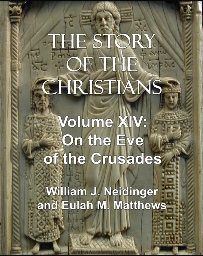 Printed Book
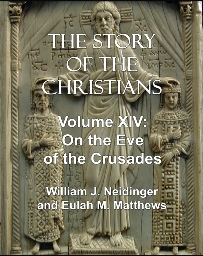 E-Book

Chapters in VOLUME XIV:
- The Northmen and Christianity
- The Holy Roman Empire
- The Normans in Southern Italy and Sicily
- Cluny, “The Light of the World”
- Islamic al-Andalus and the Christian Reconquista
- The Filioque Controversy
- The Christian Oikoumene on the Eve of the Crusades: Byzantine East and Roman West
- The Christian Oikoumene on the Eve of The Crusades: Christians under Islamic Rule
- Jerusalem on the Eve of the Crusades